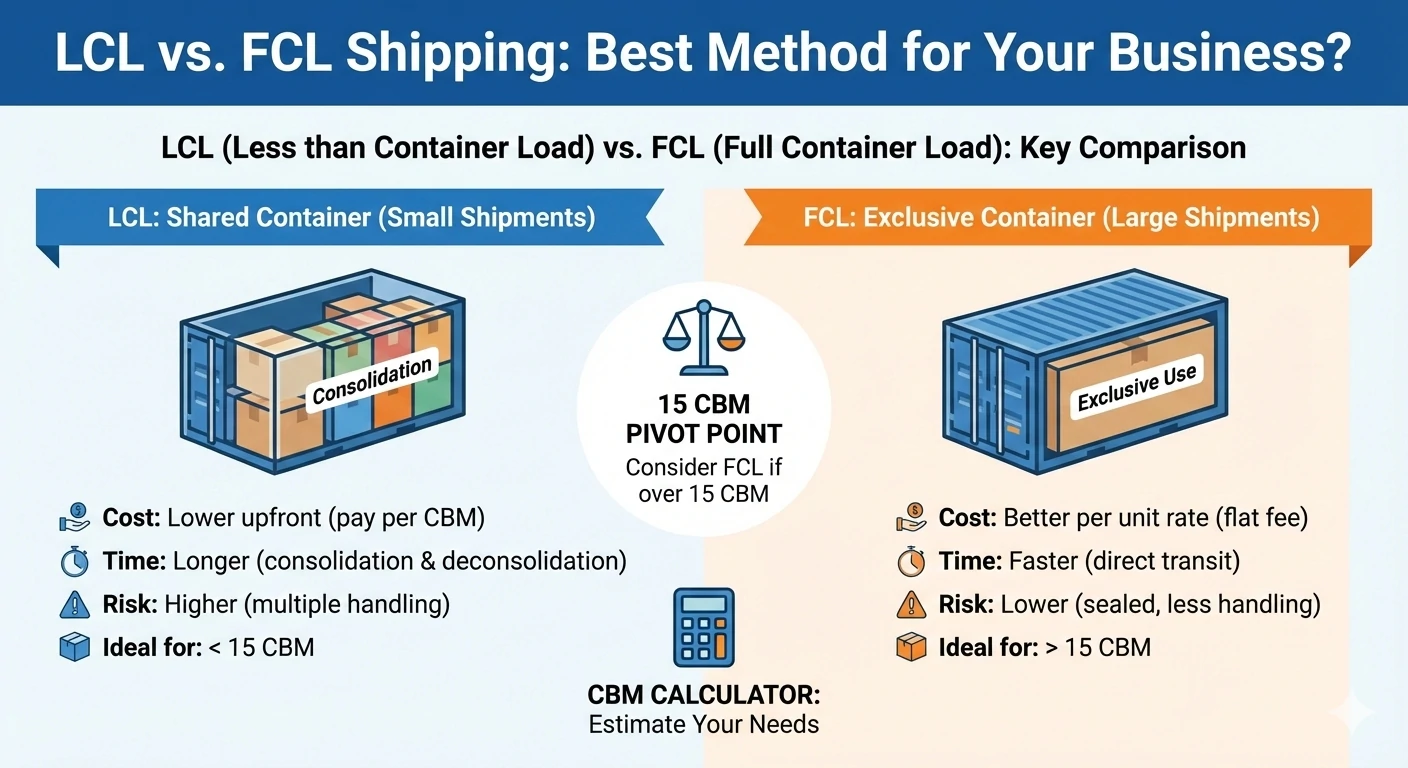
Selecting an unsuitable shipping method might silently cut down your profit margin. In case of international logistics, the choice between LCL (Less than Container Load) and FCL (Full Container Load) not just determines your shipping expenses but also impacts your delivery duration, cargo safety, and the efficiency of the entire supply chain.
There are importers who only look at the cost per CBM — and do not realize the hidden risks, delays, and extra fees resulting from the wrong choice. In this article, we present LCL vs. FCL shipping from a perspective of cost, time, and risk, enabling you to select the most effective method for your company.
1. What Is LCL and FCL Shipping? (Basic Definitions)
Before comparing performance, let us first explain the fcl shipping meaning and its difference from less than container load.
LCL (Less than Container Load)
LCL means your cargo does not fill an entire container, so it is combined with shipments from other shippers. You pay only for the space your goods occupy, usually calculated in CBM (cubic meters).
LCL shipments go through two extra processes:
- Consolidation at the origin warehouse
- Deconsolidation at the destination warehouse
This makes LCL flexible for small shipments — but also slower and riskier.
FCL (Full Container Load)
FCL means you book the entire container, even if it is not completely full. Your cargo stays in one sealed container from origin to destination, with no mixing or re-handling.
FCL is preferred for:
- Large-volume shipments
- High-value or fragile cargo
- Businesses that need predictable delivery times
If you want expert guidance on choosing the right container strategy, a professional logistics partner like Forest Leopard can help you optimize both cost and performance.
2. Shipping Cost Comparison: The 15 CBM “Pivot Point”
Many shippers assume LCL is always cheaper. That’s only true up to a certain volume.
How LCL Costs Are Calculated
With LCL, you pay per CBM. The price includes:
- Ocean freight per CBM
- Consolidation fees
- Deconsolidation fees
- Warehouse handling
- Documentation charges
As your shipment grows, these “per-CBM” fees stack up quickly.
Why FCL Becomes Cheaper Around 15 CBM
At approximately 12–15 CBM, LCL and FCL costs often intersect. This is the pivot point where:
- LCL total cost ≈ FCL total cost
- Beyond this point, FCL becomes cheaper
Why?
Because FCL has fixed container pricing, while LCL keeps charging per CBM plus handling fees.
Use a CBM Calculator to Decide
A simple cbm calculator can help estimate your shipment volume and identify whether LCL or FCL is more cost-efficient.
Pro Tip:
If your cargo is over 15 CBM, FCL usually saves money — and reduces risk.
Forest Leopard offers professional volume assessments and shipping cost optimization for exporters and importers worldwide.
3. Speed Comparison: Why LCL Is Slower Than FCL
Time is money in global trade. The shipping method you choose directly impacts your delivery schedule.
Why LCL Takes Longer
LCL shipments require:
- Waiting for other cargo to fill the container
- Consolidation at the origin
- Deconsolidation at the destination
- Additional customs processing
Each step adds extra days to the transit time.
Delays are common when:
- Other shippers miss deadlines
- Containers are not fully loaded
- Warehouses face congestion
Why FCL Is Faster
FCL containers:
- Move directly to the port
- Skip consolidation
- Clear customs faster
- Go straight to the final destination
This makes FCL ideal for:
- Time-sensitive goods
- Seasonal inventory
- Amazon FBA shipments
- Production materials
If delivery speed matters to your business, FCL offers a clear advantage.
4. Risk Comparison: Cargo Safety & Damage Exposure
Shipping risk isn’t just about loss — it’s about handling frequency.
Higher Risk with LCL
LCL cargo is:
- Loaded and unloaded multiple times
- Mixed with other shippers’ goods
- Handled in busy warehouses
This increases the risk of:
- Physical damage
- Moisture exposure
- Misplacement
- Label confusion
Fragile or high-value items suffer the most under LCL conditions.
Lower Risk with FCL
With FCL:
- Cargo stays in one sealed container
- No mixing with other shipments
- Minimal handling
This drastically reduces the chance of damage or loss.
For businesses shipping electronics, machinery, or branded products, FCL offers better protection and peace of mind.
Forest Leopard provides professional container loading, inspection, and cargo protection services to minimize shipping risks.
5. LCL vs. FCL Summary Table
| Factor |
LCL (Less than Container Load) |
FCL (Full Container Load) |
| Cost |
Cheaper for < 12–15 CBM |
Cheaper for > 15 CBM |
| Speed |
Slower due to consolidation |
Faster, direct shipping |
| Risk |
Higher handling risk |
Lower risk |
| Flexibility |
Good for small shipments |
Best for large shipments |
| Security |
Shared container |
Exclusive container |
6. Which Shipping Method Is Best for You?
Choose LCL if:
- Your shipment is under 10–12 CBM
- You are testing a new market
- Budget is more important than speed
Choose FCL if:
- Your shipment is over 15 CBM
- You need faster delivery
- Your cargo is fragile or valuable
- You want better cost control
The right decision depends on volume, urgency, and risk tolerance — not just price.
Final Thoughts: Smart Shipping Saves More Than Money
The shipping cost represents just one section of the equation. Besides, delays, damage, and inefficiency can silently eat up your business to an extent that it is higher than a freight rate that is more expensive.
Understanding the differences between lcl vs fcl, using a cbm calculator, and choosing the right shipping method all contribute to protecting your profit, timeline, and reputation.
If you want expert guidance, accurate shipping cost comparisons, and reliable global logistics support, Forest Leopard is ready to help you ship smarter.

 EN
EN
 FR
FR
 ES
ES
 JA
JA
 PT
PT
 RU
RU
 AR
AR
 中文
中文