Imagine this: Your goods have finally arrived at the Long Beach port. You are ready to sell. Suddenly, you get a notice from US Customs (CBP). Your cargo is on hold, and you have been slapped with a $5,000 penalty.
Why? Because you missed a simple digital paperwork step called ISF.
If you are shipping ocean freight from China to the USA, knowing about ISF (Importer Security Filing) is not optional—it is mandatory. In this guide, we break down what the "10+2 Rule" is in plain English, why it exists, and how to file it correctly to keep your money in your pocket.
What is ISF (Importer Security Filing)?
ISF, commonly known as the "10+2 Rule," is a US Customs and Border Protection (CBP) regulation specific to ocean cargo imports.
Think of it like a "background check" for your cargo. Before a passenger gets on a plane to the US, the airline sends their passport data to security. Similarly, before your container gets loaded onto a ship in China, US Customs wants to know exactly who is sending it and what is inside.
- The "10": Data elements that must be provided by the Importer (or their agent).
- The "2": Data elements provided by the Carrier (Steamship Line).
Note: ISF is ONLY for ocean freight. If you are shipping via Air Freight, you do not need to file ISF.
The "Golden Rule": The 24-Hour Deadline
This is the most critical part of this article. You must file the ISF at least 24 hours BEFORE the cargo is loaded onto the vessel at the port of origin.
Many new importers make the mistake of thinking they can file it when the ship arrives in the US. WRONG. If the ship leaves the Chinese port and you haven't filed ISF, you are already late. This puts you at risk of a penalty immediately.
What Happens If You Don't File? (The Penalties)
US Customs does not play games with security. If you fail to file ISF, file it late, or file inaccurate data, the consequences are expensive:
1. Monetary Fines: The standard penalty for a late or missing ISF is $5,000 per violation.
2. Cargo Holds: Customs may flag your container for an intensive exam (which costs you more money) or refuse to let it leave the port.
3. Do Not Load Orders: In severe cases, Customs will tell the carrier not to even load your container in China.
Who Files the ISF?
Technically, the Importer of Record (You) is responsible. However, unless you have specialized software and a direct link to US Customs, you cannot do it yourself.
You need a licensed agent to file it for you. You have two options:
1. Your Customs Broker: The person clearing your goods in the US.
2. Your Freight Forwarder: The company moving your goods.
Why Use Your Forwarder (Like Forest Leopard)? Using your freight forwarder is often safer and faster. Since we already have your Bill of Lading data and supplier info, we can file the ISF instantly without waiting for emails back and forth.
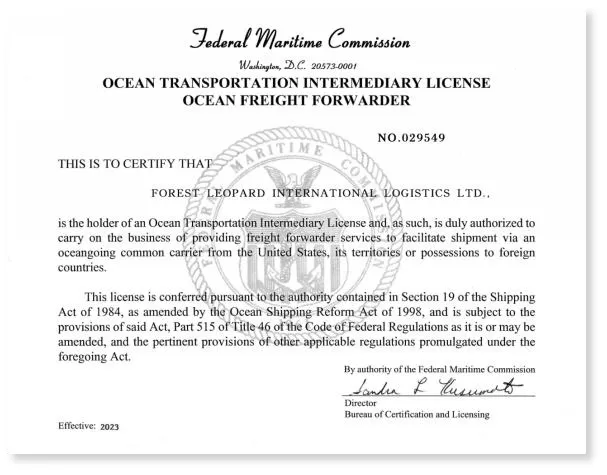
Forest Leopard is a fully licensed logistics provider with FMC (Federal Maritime Commission) qualifications. This allows us to handle US-bound shipments and data filings compliantly.
What Information Do You Need to File?
You don't need to memorize the technical codes. To file ISF, you simply need to send your forwarder these documents:
- Commercial Invoice
- Packing List
- Bill of Lading Number (House B/L or Master B/L)
Your forwarder will extract the required "10 Data Elements" from these docs, such as:
- Seller & Buyer names/addresses.
- Manufacturer (Supplier) name/address.
- HTS Codes (Harmonized Tariff Schedule).
- Consolidator name (stuffer).
How Much Does ISF Filing Cost?
The cost is very low compared to the risk.
- Average Market Rate: $25 - $50 USD per shipment.
- Penalty Cost: $5,000 USD minimum.
It is the cheapest "insurance" you will ever buy for your supply chain. At Forest Leopard, we often bundle ISF filing with our shipping services to make it seamless for you.
FAQ: Common ISF Questions
Q: Does LCL (Less than Container Load) need ISF? A: Yes. Whether you ship a full container (FCL) or just a few boxes (LCL) via sea, ISF is mandatory.
Q: Can I amend the ISF if data changes? A: Yes. It is better to file an update than to have wrong information. If your ship date changes, tell your forwarder immediately.
Q: I am shipping DDP. Do I need to worry about ISF? A: Yes, but your forwarder should handle it. If you choose Forest Leopard's DDP service, we handle the ISF filing, Customs clearance, and delivery as one package, so you don't have to stress about the paperwork.
Summary: File Early, Sleep Better
Shipping from China to the US involves many moving parts. ISF is one small step that can cause huge problems if ignored.
The Checklist for Success:
1. Finalize your order with the supplier.
2. Book shipping with a licensed forwarder (like Forest Leopard).
3. Send your documents (Invoice/Packing List) immediately.
4. Confirm ISF is filed before the ship sails.
Need help filing ISF? Don't risk the $5,000 fine. As an FMC-licensed forwarder, Forest Leopard can handle your shipping and ISF filing together.
[Contact Us for a Quote & ISF Filing Help]

 EN
EN
 FR
FR
 ES
ES
 JA
JA
 PT
PT
 RU
RU
 AR
AR
 中文
中文