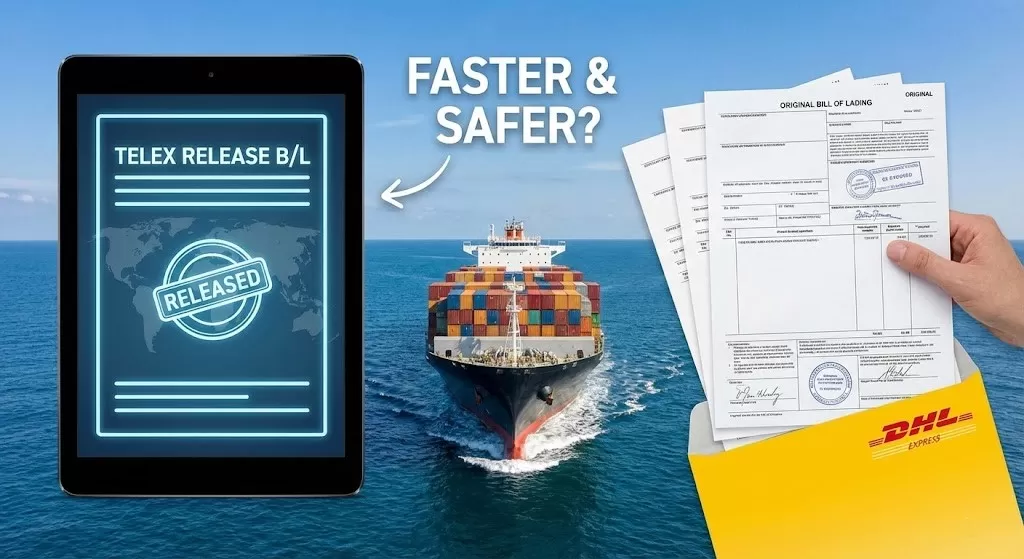
In international shipping, the Bill of Lading (B/L) is the most important document. It is the "Key to the Cargo."
Whoever holds the original B/L legally owns the goods.
But here is the problem: In the digital age, physically mailing a piece of paper from China to the USA takes 3-5 days and costs $50+. If that paper gets lost, you cannot pick up your cargo.
So, should you stick to the old-school Original B/L or switch to the faster Telex Release?
In this guide, we compare the two options to help you choose the best one for your business.
Option 1: The Original Bill of Lading (The "Hard Copy")
This is the traditional method. The carrier issues a set of 3 original paper bills.
1. Supplier gets the paper B/L from the forwarder.
2. You pay the supplier.
3. Supplier mails the paper B/L to you (via DHL/FedEx).
4. You present the paper B/L to the destination agent to release the cargo.
- Pros: Maximum security. (Goods cannot be released without the physical paper).
- Cons: Slow. Risk of loss (If FedEx loses it, getting a new one is a nightmare). Expensive courier fees.
Note: Once you receive the B/L data from the supplier, don't forget to use it for your mandatory [ISF Filing]at least 24 hours before the cargo is loaded.
Option 2: Telex Release (The "Digital" Way)
Telex Release (or "Surrender B/L") is the modern standard for most e-commerce shipments.
Instead of mailing paper, the shipper "surrenders" the original B/L to the agent in China, and the agent sends a digital "Release" message to the destination.
1. You pay the supplier.
2. Supplier tells the forwarder: "I have received payment, please release goods." (Ideally, you should only pay after the goods have passed Pre-Shipment Inspection to avoid releasing funds for defective products.)
3. Forwarder emails you the "Telex Release B/L" (a PDF file).
4. You pick up goods immediately.
Pros:
- Instant: No waiting for DHL.
- Safe: No paper to lose.
- Cheap: No courier fees.
Cons: Once released, you cannot stop the cargo (so only do this after you trust the payment is secure).
Comparison Table: Original vs. Telex
|
Feature
|
Original Bill of Lading
|
Telex Release (Surrender)
|
|
Format
|
Physical Paper (Hard Copy)
|
Digital Message / Email
|
|
Speed
|
Slow (Courier takes 3-5 days)
|
Instant
|
|
Cost
|
Courier fee ($30-$60)
|
Usually a small "Telex Fee" (or Free)
|
|
Risk
|
Paper can be lost/stolen
|
No physical loss risk
|
|
Best For
|
New suppliers (Trust not established)
|
Trusted suppliers / Amazon FBA
|
Pro Tip: This comparison applies to Sea Freight. If you are shipping via urgent Air Freight , the document used is an Air Waybill (AWB), which functions differently and is not a title document like the B/L.
Why Use a "House Bill of Lading" (HBL)?
Many new importers are confused: “Why did my forwarder give me their own B/L instead of the shipping line's B/L?”
This is actually for your benefit.
A House Bill of Lading (HBL) is issued by a licensed NVOCC (like Forest Leopard).
The Forest Leopard Advantage:
- Flexibility: If you need to change the delivery address (e.g., to a different Amazon warehouse) last minute, it is much easier to amend an HBL than a Master B/L from a rigid steamship line.
- Privacy: An HBL can hide your supplier's name from the final receiver (useful if you are drop-shipping).
- FMC Protection: As an FMC-licensed NVOCC, our HBL is fully recognized by US Customs and banking systems.
- Consolidation: An HBL allows us to combine cargo from multiple suppliers onto one document, significantly lowering your total Amazon FBA Shipping Costs.
Summary: Which One Should You Choose?
- Choose Original B/L if: It is your very first time working with a supplier, and you want to ensure they don't get paid until you see the B/L copy.
- Choose Telex Release if: You have paid the supplier in full (T/T 100%), or you are shipping to Amazon FBA (where speed is everything).
Still confused about paperwork?
At Forest Leopard, we simplify the process. We default to the fastest, safest option for your specific shipment so you never have to worry about "lost paper."
[Get a Quote & Simplify Your Shipping]

 EN
EN
 FR
FR
 ES
ES
 JA
JA
 PT
PT
 RU
RU
 AR
AR
 中文
中文