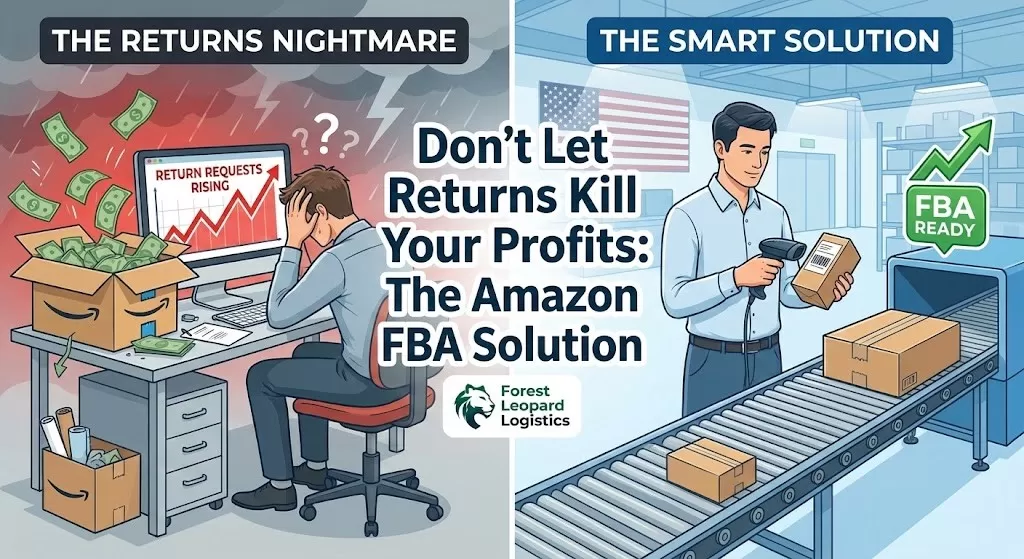
Let’s face it: There is no sound more terrifying for an e-commerce seller than the notification of a return request.
You did everything right. You sourced a great product, you paid for freight forwarding from China, and you launched your ads. But now, the customer wants to send it back.
For domestic US sellers, a return is just an annoyance. But for international sellers (especially those shipping from China), an Amazon FBA return can feel like a financial disaster. Between international shipping fees, customs duties(especially if you aren't using DDP shipping), and Amazon’s rising disposal fees, your profit margin can vanish in seconds.
This is the "Cross-Border Nightmare": Your inventory is stuck overseas, bleeding money.
But here is the good news: Returns don’t have to be a total loss. By understanding Amazon return reasons and using a smart US warehouse strategy, you can turn those "unfulfillable" units back into cash.
The Harsh Reality: Why Shipping Returns Back to China Fails
When a customer returns a product to an Amazon fulfillment center, and Amazon marks it as "Unfulfillable," you typically face three choices:
1. Disposal: You pay Amazon to destroy your product. (Total loss).
2. Return to China: You pay to ship it all the way back to your factory.
3. Liquidation: You sell it for pennies on the dollar.
Let’s do the math on option #2. Shipping individual items back to China is almost never worth it. The air freight cost for a single returned package often exceeds the value of the product itself. This is why many sellers simply give up and let Amazon destroy their inventory.
That is literally burning money.
Understanding the Data: Common Amazon Return Reasons
To fix the problem, we need to look at why customers are returning items. According to search trends and seller data, the most common Amazon return reasons usually fall into three buckets:
- "No longer needed" / "Bought by mistake": The product is pristine; the customer just changed their mind.
- "Packaging damaged": The box was crushed in transit, but the product inside is perfect.
- "Defective": Often, this is just user error (the customer didn't know how to use it).
Here is the kicker: In more than 50% of these cases, the product is actually still sellable. It isn't "garbage"; it just needs a quick check and a new label.
If you leave it at Amazon, it’s dead inventory. If you move it to a US overseas warehouse, it’s a second chance.
The Solution: The "Removal Order" Strategy
Smart international sellers don’t ship returns back to China. They use a local strategy. This is where having a logistics partner with a US warehouse (like Forest Leopard’s facilities in Los Angeles or New York) changes the game.
Here is the step-by-step process to stop losing money on reverse logistics:
Step 1: Create an FBA Removal Order
Instead of destroying the inventory, log into Seller Central and create a "Removal Order." Have Amazon ship the goods to a local third-party logistics (3PL) warehouse in the US.
- Why? Amazon’s removal fees to a local US address are significantly cheaper than international shipping or disposal fees for high-value items.
Step 2: Inspection and Grading
Once your goods arrive at the Forest Leopard warehouse, our team performs a professional inspection.
- Is it truly damaged? We can dispose of it for you locally.
- Is it brand new? Great! It goes to the next step.
- Is the box damaged? We can swap the packaging to make it look new again.
This step is crucial. You need "eyes" on the ground to tell you the real condition of your stock.
Step 3: Relabeling and Restocking (The Profit Saver)
This is the magic moment. Amazon FBA requires specific barcodes (FNSKU). Once a product is returned, that specific label is often flagged.
A professional FBA prep service will:
1. Remove the old FBA label.
2. Apply a brand new FNSKU label.
3. Repackage the item securely.
Now, that "returned" item is effectively new inventory. You can send it back to Amazon FBA to be sold again, or fulfill it on another platform like eBay, Walmart, or TikTok Shop.
Summary: Turn Your Returns Strategy into a Competitive Advantage
Don’t look at returns as a logistics nightmare. Look at them as a puzzle to be solved.
- The Old Way (Losing Money): Customer Returns -> Amazon Warehouse -> Destroyed / Shipped to China -> Total Loss.
- The Smart Way (Forest Leopard Way): Customer Returns -> FBA Removal Order -> US Local Warehouse -> Inspect & Relabel -> Back to FBA -> Profit.
Your products are valuable assets. Don’t let them go to waste just because they are in the wrong building. If you are looking for a reliable partner to handle your freight forwarding and FBA removal orders, Forest Leopard is here to help you keep more of your hard-earned dollars.
Ready to stop burning money on returns? Contact Forest Leopard today to get a quote for our US Warehouse and Return Management services.
Frequently Asked Questions (FAQ)
Q: Is it cheaper to destroy FBA inventory or remove it? A: It depends on the item's value. However, Amazon has increased disposal fees. For most items worth over $15, using a removal order to a local US warehouse for relabeling is usually more profitable than disposal.
Q: Can Forest Leopard handle Amazon removal orders? A: Yes. We have warehouses in Los Angeles (West Coast) and New York (East Coast) specifically designed to receive removal orders, inspect goods, and provide relabeling services.
Q: What is the benefit of a US warehouse for Chinese sellers? A: It acts as a local buffer. You can store bulk inventory (cheaper storage than Amazon), handle returns locally, and restock FBA rapidly without waiting for sea freight shipping from China.

 EN
EN
 FR
FR
 ES
ES
 JA
JA
 PT
PT
 RU
RU
 AR
AR
 中文
中文