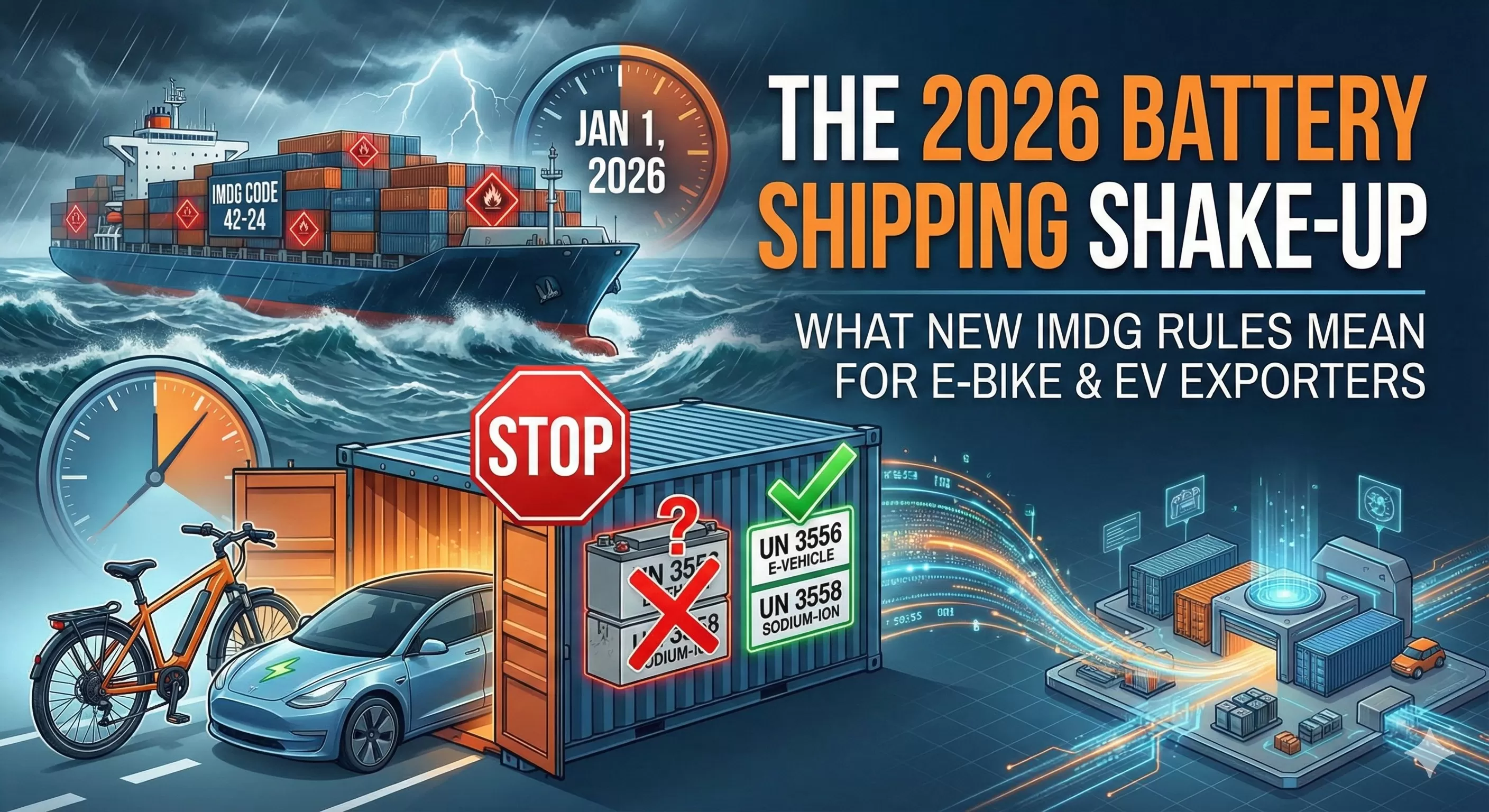
If you are importing E-bikes, E-scooters, or the new generation of Sodium-ion batteries from China, your supply chain is about to face a major regulatory checkpoint.With the IMDG amendments becoming mandatory in 2026 (specifically Amendment 42-24), shippers face a strict deadline.
⚠️Urgent Compliance Alert: For years, shippers operated in a "grey area" regarding battery classifications. That ends on Jan 1, 2026. With the new IMDG 42-24 amendment, ambiguous declarations will lead to cargo seizures. Forest Leopard has updated our SOPs to ensure 100% compliance for the new UN 3556/3557/3558 classifications.
The new amendment introduces specific UN numbers for vehicles and formally regulates Sodium-ion batteries as Dangerous Goods.If your documentation is outdated, carriers will reject your booking, and Customs may detain your container.
At Forest Leopard, we have already updated our SOPs. Here is what US importers—especially those sourcing from the Shenzhen electronics supply chain—need to know to avoid cargo seizure in 2026.
The Direct Answer: What Is Changing?
The biggest change is specificity. The days of loosely declaring everything under generic codes are over. Before diving into these new 2026 rules, ensure your foundation is solid by reviewing the basics of shipping batteries and UN38.3 compliance.
- Sodium-Ion Batteries are now officially regulated as Class 9 Dangerous Goods, similar to Lithium-ion.
- Battery-Powered Vehicles (like E-bikes and E-scooters) get their own dedicated UN numbers (UN 3556, 3557, 3558), separating them from loose batteries.
- Warning: If your paperwork after Jan 1, 2026, still uses the old, generic classifications for these specific items, carriers will reject your booking, and Customs may detain your container.
1. The New "Vehicle" Classifications (UN 3556, 3557, 3558)
Previously, there was confusion about how to classify an E-scooter vs. a loose battery pack. The new amendment clears this up.
If you are shipping Battery-Powered Vehicles from China to the USA, you must now use these specific codes:
|
New UN Number
|
Description
|
Application Example
|
|
UN 3556
|
Vehicle, Lithium-ion Battery Powered
|
Tesla EVs, E-bikes, E-scooters (with Li-ion)
|
|
UN 3557
|
Vehicle, Lithium Metal Battery Powered
|
Specialized industrial vehicles
|
|
UN 3558
|
Vehicle, Sodium-ion Battery Powered
|
The new wave of Sodium-powered E-scooters
|
Forest Leopard Insight: This change means your MSDS (Material Safety Data Sheet) must be updated. You cannot use an MSDS for a "Battery" to ship a "Vehicle" anymore. Our team in Shenzhen can help review your factory’s documentation before booking to ensure it matches these new codes.
2. Sodium-Ion Batteries: No Longer a "General Cargo" Loophole
Sodium-ion (Na-ion) technology is exploding in popularity due to lower costs. Until recently, many forwarders shipped these as "General Cargo" because regulations were vague.
The Loophole is Closed.
Under IMDG 42-24, Sodium-ion batteries are now strictly Class 9 Dangerous Goods.
- Proper Shipping Name: BATTERIES, SODIUM ION.
- Special Provisions: They are subject to similar testing requirements as Lithium batteries (UN 38.3 equivalent).
- Marking: Packages must display the Class 9 Lithium/Battery mark (the striped diamond).
What This Means for You:
If you were enjoying cheap "General Cargo" shipping rates for Sodium batteries, expect prices to adjust. You now require DG packaging and DG certified vessels. Forest Leopard has secured DG space allocations specifically for this growing category on the Trans-Pacific lane.
3. The "State of Charge" (SoC) Rule
Safety is the driver behind these rules. For sea freight, the State of Charge (SoC) limit is strictly enforced to prevent thermal runaway (fires) inside containers.
- The Rule: Batteries should generally be shipped at a SoC not exceeding 30% of their rated capacity.
- The Risk: High SoC = Higher risk of fire. Shipping lines like Maersk, COSCO, and MSC are increasing spot checks.
At our Shenzhen and Hong Kong warehouses, Forest Leopard provides a pre-shipment check. We ensure your factory hasn't overcharged the units before they are loaded into the container, saving you from costly "Return to Shipper" fees at the port gate.
Shipping DG cargo isn't just about moving a box; it's about paperwork and safety. Here is how we handle your sensitive battery shipments:
- UN 38.3 & MSDS Verification: We don't just take the factory's word for it. We verify the authenticity of the test reports to ensure they meet the 2026 standards.
- Correct Labeling: We ensure the new UN 3556/3557/3558 labels are applied correctly to the outer cartons.
- DG Container Booking: We book directly with carriers that accept Class 9 goods (ZIM, Matson, CMA CGM), ensuring your cargo isn't bumped off the vessel.
- DDP Service for Batteries: We offer a Delivered Duty Paid solution for battery products. We handle the complex hazmat customs clearance in the US and deliver directly to your warehouse or Amazon FBA.
Final Thoughts: Prepare Now, Don't Panic Later
The transition to IMDG Amendment 42-24 is mandatory. The "grace period" (2025) is ending.Confused by the new rules? Don't worry. We have created a complete step-by-step manual for you. Read our [Ultimate Guide to Shipping Batteries in 2026] to get the full packing checklist and document templates.
If you are an exporter of E-mobility devices or advanced batteries, the time to update your packaging and paperwork is now. Don't wait until your container is held up in Yantian or Long Beach in January.
Need a compliance check for your battery products?
Contact Forest Leopard's DG Team today. We will review your MSDS and provide a safe, compliant shipping route for 2026.
Frequently Asked Questions (2026 Update)
Q: What is the difference between UN 3171 and the new UN 3556?
A: UN 3171 was the old catch-all for battery-powered vehicles. Starting 2026, you must use UN 3556 specifically for vehicles powered by Lithium-ion batteries to strictly distinguish them from Sodium-ion or Lithium-metal vehicles.
Q: Will shipping costs increase for Sodium-ion batteries in 2026?
A: Likely yes. Since Sodium-ion is now officially Class 9 Dangerous Goods (no longer General Cargo), you must use DG-certified vessels. Expect a 10-15% market rate adjustment.
Q: What happens if I misdeclare my E-scooters under the old codes?
A: Carriers are implementing strict automated filters. Misdeclared bookings will be rejected, or worse, containers may be held at origin ports like Yantian, incurring daily storage fees.

 EN
EN
 FR
FR
 ES
ES
 JA
JA
 PT
PT
 RU
RU
 AR
AR
 中文
中文