Let's have a serious conversation about your profit margins.
You spend weeks negotiating with your supplier to shave $0.50 off the product cost. You fight for every cent. But then, the goods are ready, you pay the shipping invoice, and suddenly... all that profit you fought for is gone. 💸
Why? Because shipping rates in 2026 are ruthless.
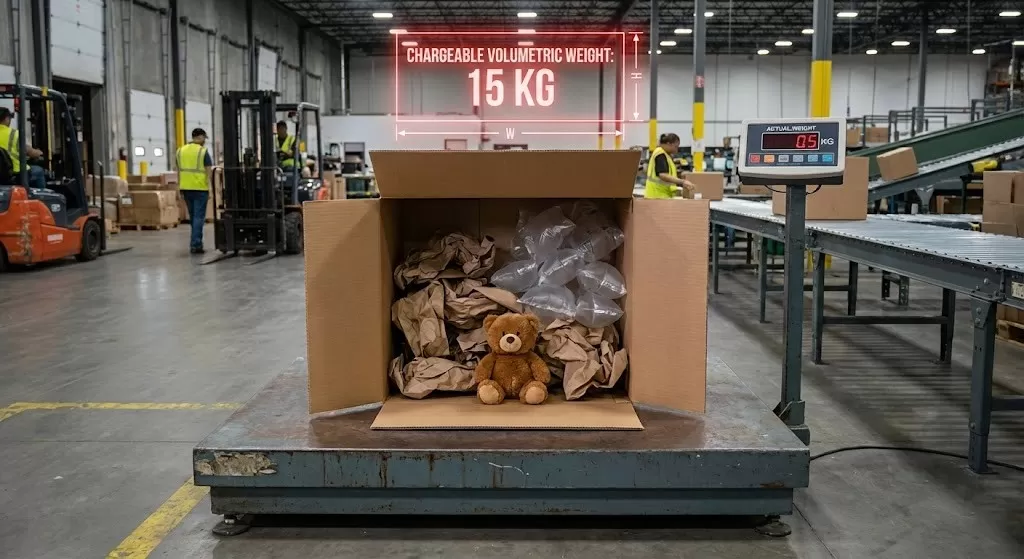
But here is the "dirty little secret" that most logistics companies won't tell you: You aren't just paying for the weight of your product. You are paying for the air inside the box.
At Forest Leopard, we see this tragedy every single day on our warehouse floor. We open cartons and see 60% product, 40% empty space and bubble wrap. It hurts us to watch our clients pay for that space.
Today, I want to show you exactly why this happens, and how our "Volume Optimization" protocol can put that money back in your pocket.
The Trap: Actual Weight vs. Volumetric Weight ⚖️
If you are new to importing, or even if you've been doing it for a while, this concept is the #1 silent killer of profits.
Carriers (DHL, UPS, FedEx, and even Sea Freight) don't care how light your product is. They care about how much space it takes up on the plane or the boat.
They use a formula called Dimensional Weight (Dim Weight):
Length x Width x Height / 5000 (for Express)
Here is a real-world example: Imagine you are shipping Plush Toys or Pillows.
- Actual Weight on the scale: 10kg.
- The Size of the Box: It's huge. Based on the formula above, the carrier says the "Volumetric Weight" is 35kg.
Guess which one they charge you for? They charge you for the 35kg. You are paying for 25kg of "phantom weight" that doesn't exist! It's just air.
Why Do Factories Do This? (The Industry Truth)🏭
You might ask: "Why doesn't my supplier just pack it better?"
This is something we explain to clients all the time. Your supplier is an expert at Manufacturing, not Logistics.
- Speed over Precision: Factory packers are paid by speed. Throwing things loosely into a big box is faster than carefully arranging them like a game of Tetris.
- Using What's Available: If they run out of the perfect-sized box, they won't wait. They will grab the next biggest box size and fill the empty space with cheap fillers.
- Lack of Incentive: They don't pay the shipping bill. You do. So they have no motivation to squeeze the volume down.
This is where Forest Leopard steps in. We are on your side of the transaction.
How We Fight Back: The Forest Leopard Optimization Process🛠️
When your goods arrive at any of our warehouses (whether in Shenzhen, Yiwu, or elsewhere), we don't just blindly label them and ship them out. We act as your final line of defense.
Here are the three specific strategies we use to slash your shipping bill:
1. The "Vacuum Protocol" (For Soft Goods)🧸
If you are selling anything made of fabric—clothes, bedding, plush toys, pet beds—you absolutely must use this service.
We use industrial-strength vacuum sealing machines.
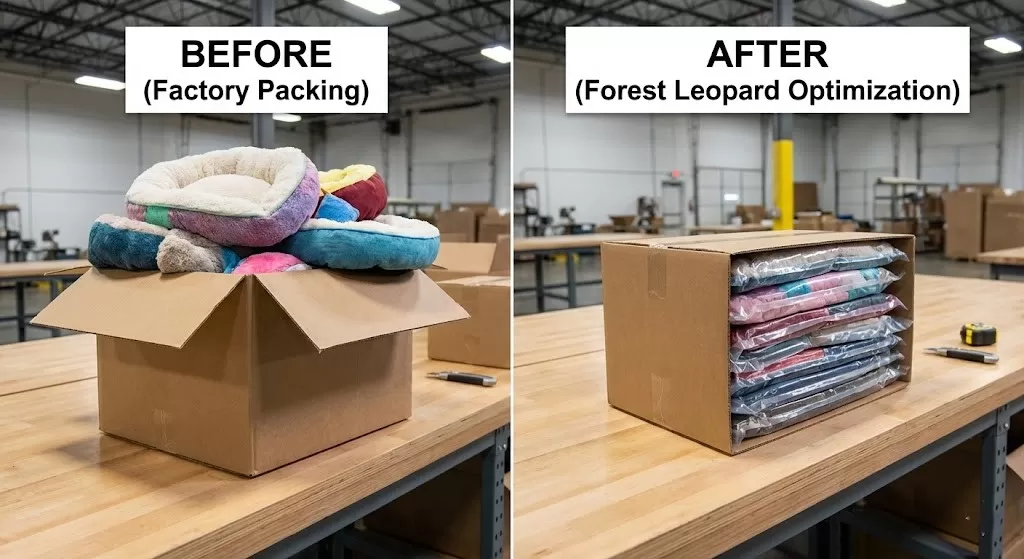
- Before: A fluffy dog bed takes up 0.08 CBM (Cubic Meters).
- After: We suck the air out, and it becomes a flat, hard brick taking up only 0.02 CBM.
The Result: You can fit 4x as many units in the same box. Your shipping cost per unit just dropped by 75%. This isn't magic; it's just physics.
2. The "Carton Swap" Strategy📦
We often see factories using cheap, flimsy cardboard boxes that have bulged out of shape, adding unnecessary inches to the measurements.
We take your products out and repack them into High-Density, Double-Wall Export Cartons.
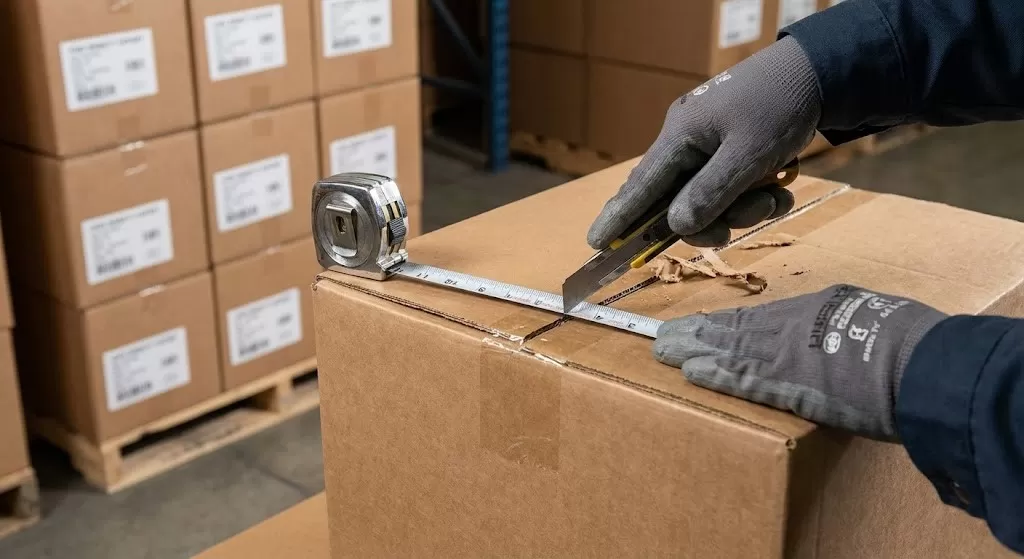
- We cut down the box to fit the product exactly. No wiggle room.
- By shaving off just 2cm from each side of a master carton, we can save you hundreds of dollars on a large shipment.
- Bonus: These tougher boxes protect your goods better than the cheap factory boxes, reducing your return rate on Amazon.
3. Smart Consolidation (The "Tetris" Method)🧩
Are you sourcing from three different suppliers?
- Supplier A: Heavy metal parts (High weight, low volume).
- Supplier B: Plastic containers (Low weight, high volume).
If you ship them separately, Supplier B's shipment will cost a fortune in "Volumetric Weight." The Solution: We combine them. We use the heavy metal parts to fill the empty spaces inside or around the plastic containers. The heavy items offset the light items, balancing the shipment so you get the best possible rate.
A Real Case Study: The $1,200 Savings💰
Let's look at a recent client of ours, Sarah, who sells Yoga Mats and Foam Rollers.
The Situation: The factory packed 200 foam rollers in massive boxes.
- Quoted Shipping Cost (Direct from Factory): $3,800 (Due to huge volume).
The Forest Leopard Intervention: Sarah sent the goods to our warehouse first.
1. We noticed the rollers were hollow in the middle.
2. We "nested" other smaller items inside the rollers.
3. We re-packed them into custom-sized cartons that eliminated 4 inches of headspace per box.
The New Shipping Cost: $2,600. Total Savings: $1,200!
That $1,200 didn't go to FedEx. It went straight into Sarah's marketing budget.
Conclusion: We Measure Twice, So You Pay Once📏
Logistics shouldn't be a black box where you just pay whatever the invoice says. It requires strategy.
At Forest Leopard, we treat your money like it's our money. We hate wasting space as much as you do.
Do you suspect you are paying to ship air? Before you book your next shipment, let us take a look. Send us your packing list, and we will give you a free analysis of how much volume (and money) we can save you.
👉Contact Our Team for a Volume Analysis

 EN
EN
 FR
FR
 ES
ES
 JA
JA
 PT
PT
 RU
RU
 AR
AR
 中文
中文